Helping Snakes Find a Safe Winter Shelter on Jekyll Island

by Yank Moore, Director of Conservation, Joseph Colbert, Wildlife Biologist, and Michael Brennan, University of Georgia PhD student

Jekyll Island is a beautiful place full of wildlife, but for one special snake, life there can be tricky, especially during the cold winter months. The Eastern Diamondback Rattlesnake (EDB), the largest rattlesnake in the world, faces many challenges as it moves around the island. Each year, these snakes travel between their foraging areas in search of winter homes. Sometimes, roads and trails fragment their natural habitats, making movement risky.

In other parts of the United States, including New Jersey and Arizona, wildlife managers have found a clever solution: creating winter sheltering sites in areas that prevent snakes from crossing dangerous zones.

Artificial refugia are safe underground shelters that snakes and other native species can use when natural hiding spots are limited or hard to find. These shelters provide snakes, insects, and even mammals a place to rest and stay warm enough to survive the cold winter months. Until recently, no one had used artificial refugia in the Southeast until a generous donor recognized the importance of what the conservation department and UGA Ph.D. student Michael Brennan were trying to accomplish and gave the team a jumpstart to optimize different designs.

Working with UGA, the conservation team identified spots where snakes are most at risk from roads or human activity. At each site, they dig a shallow hole and build a small “snake bunker” by strategically placing cinder blocks and a protective wooden roof. Once finished, the team covers the bunkers with soil and plants native grasses on top to help them blend into the landscape. The bunkers have two entrance holes, ideally facing southwest and northeast, to let in the winter sun during the morning and afternoon. Cameras and temperature sensors have recently been installed to track how snakes use these shelters and to see what other species share these essential refugia in winter.

The team has already piloted multiple designs, with another scheduled for deployment in the coming weeks. The first was placed deep in the brush adjacent to salt marsh habitat on an elevated ridge to expose it to direct sun and prevent flooding from high tides. To the untrained eye, this bunker is invisible and blends flawlessly into the landscape. Snakes, opossums, and native rodents have already been seen using artificial refugia, and the conservation team is hopeful it will continue to be used as temperatures drop.

The second design was deployed out of necessity. One of our tracked snakes was found in an active construction zone this past winter. Under those conditions, it would not have been able to escape the area during such cold temperatures. The conservation team decided to move the snake to the nearest safe space outside the construction zone into a newly built artificial refugia. Because of the snake’s natural homing tendencies during warmer weather, the team also created a pen enclosure to prevent it from reentering the construction site. The snake was observed basking on top of the bunker on warm sunny days and staying near the openings on cooler days, exactly what the refugia components were designed for.

Since the last bunker was easier to access and offered a more controlled environment, researchers were able to closely monitor it and learn how to improve future designs. With that success in mind, the next new and improved design being deployed in the coming days will utilize corrugated culvert pipe cut to keep a natural bottom, connecting two smaller artificial refugia at different elevations. This mimics gopher tortoise burrows, which EDBs and other native species are well documented using. Gopher tortoise burrows support hundreds of species in winter, where animals and insects can enjoy 65-degree temperatures during the coldest months. UGA students and the conservation team will continually monitor these underground wildlife bunkers for years to come to see how many species use them and whether the same individuals return to these shelters as their winter retreat.

If successful, these safe winter shelters will be used effectively for priority wildlife residents year after year, and the designs will be shared broadly with wildlife managers across the Southeast to help protect rattlesnakes and other species. By giving Eastern Diamondbacks and other native species a few cozy, well-placed homes, we can help them stay safe and keep Jekyll Island’s ecosystems healthy for years to come.

Snakes on the Grid: Conservation Powered by Data

By Michael Brennan, PhD Student at the University of Georgia Warnell School of Forestry and Natural Resources

As part of the Acres and Acres of Muhly Grass project, a cutting-edge node network and Bluetooth transmitter system has been deployed to study Eastern Diamondback Rattlesnakes (EDBs) within newly restored habitats. This advanced equipment, made possible by generous donors of the Jekyll Island Foundation, is now beginning to provide insights that were previously unattainable.

The automated tracking grid delivers spatial data at a much finer scale than traditional VHF telemetry methods, while significantly reducing the labor hours required for monitoring. This marks the first study to examine how EDBs respond to restored environments, establishing a new benchmark in habitat restoration research.

Bluetooth transmitters enable safe tracking of neonatal EDBs, addressing a critical gap in understanding the early life-stages of these snakes—a period historically difficult to study due to their small size and secretive behavior.

EDBs exhibit strong home range fidelity, typically remaining within familiar territories. Observing how individuals across all age classes interact with newly available habitat will inform future conservation strategies and land management decisions.

The node network is designed to be scalable across species, including animals as small as butterflies. However, with over a decade of data on rattlesnakes, EDBs provide the most meaningful baseline for comparing pre- and post-restoration conditions.

Soon, three snakes across Jekyll Island will be equipped with transmitters, expanding the scope of the study and enhancing the understanding of movement patterns and habitat use.

This technological advancement strengthens ecological research and demonstrates how innovation—supported by community contributions—can lead to more efficient and impactful conservation practices, ensuring restored habitats effectively support native wildlife. to partner in the conservation efforts of Jekyll Island, click HERE.

Eastern Diamondback Rattlesnakes on Jekyll Island

By Joseph Colbert, JIA Wildlife Biologist

Last year through support from Jekyll Island Foundation donors, the Jekyll Island Authority Conservation department research team introduced its Eastern Diamondback Health Study (EDHS). When the study began, a search of resources and known literature was conducted to learn more about snake health only to discover there is very little information available on the subject. This is particularly true of the eastern diamondback rattlesnakes that researchers have been working with for a decade on the island, which presented an opportunity for the first Jekyll Island study of its kind.

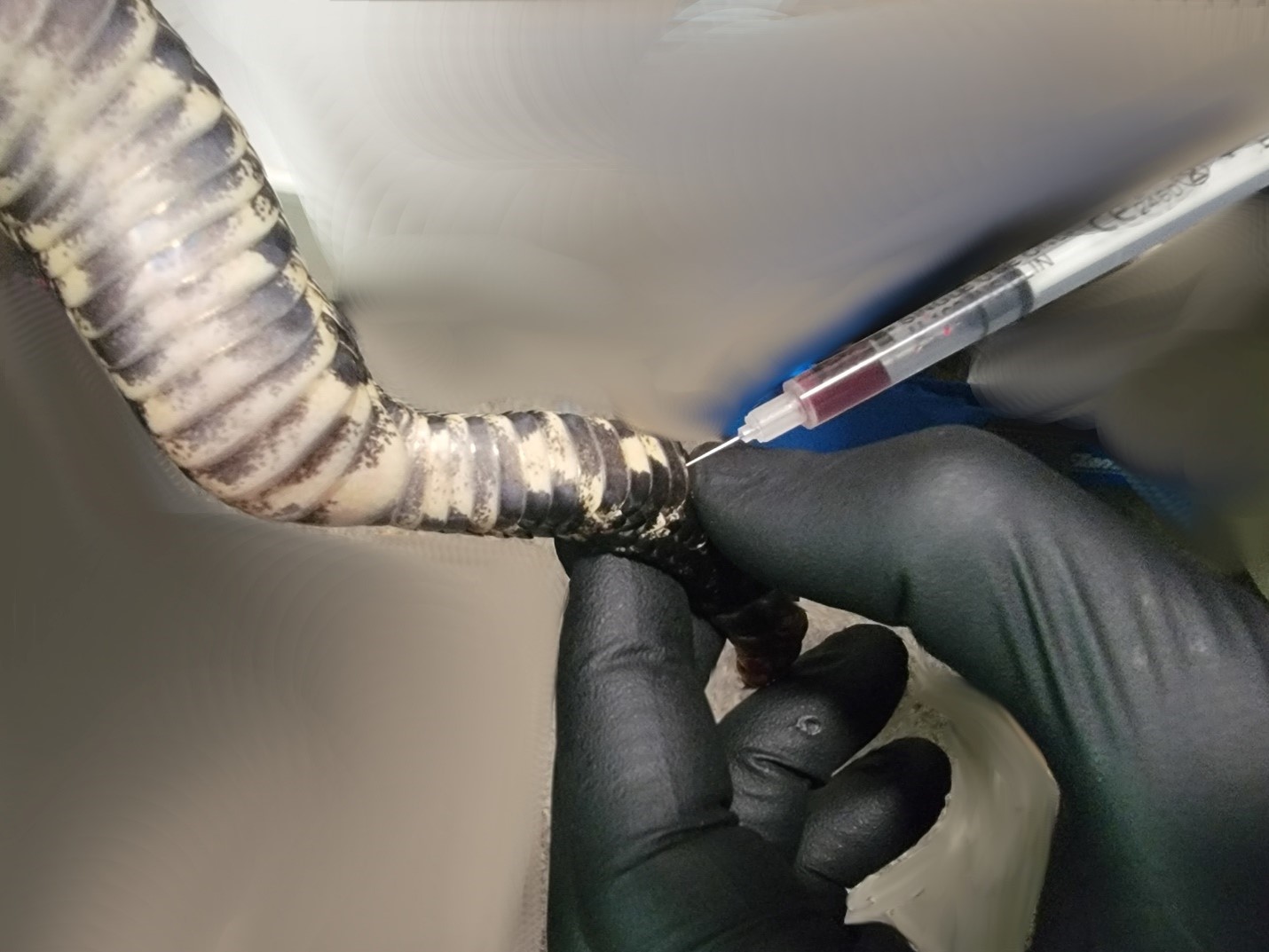
The purpose of the EDHS was to evaluate what blood chemistry can reveal about snake health. For example, when people go to a doctor for a check-up, they provide a blood sample, and if the results show they are high or low in a specific value, such as calcium, proteins, or triglycerides, those results give the doctor information about the health of their patient. Likewise, animals that are healthy or unhealthy also have blood chemistry that falls within a specific range of values. As a result of the bloodwork study, the research team now has detailed health information for eastern diamondback rattlesnakes on Jekyll Island and are working on publishing these results in scientific literature so other wildlife biologists and veterinarians can reference. This breakthrough information reveals when a snake is sick or under stress which, unlike some other animal species, is difficult or impossible to know by just looking at them.

However, the most exciting discovery is that before becoming pregnant, females have elevated levels of calcium, phosphorus, and triglycerides up to 12 months prior to giving birth. This is remarkable because snakes only gestate (carry) for approximately 6-7 months. Because researchers seek to secure the future of native wildlife that utilize Jekyll Island, understanding reproduction dynamics is key. When tracking eastern diamondbacks, staff is often able to observe pregnant females or witness that they’ve given birth (rattlesnakes bear live young). By comparing the blood chemistry of the 6 females in the study with blood taken from 50 other snakes, the team now confirms that pregnancy can be predicted in eastern diamondback rattlesnakes, another major first. Researchers believe these results are likely to apply to other reptile species in need of conservation. By sampling individuals in a specific location, biologists can use Jekyll Island research results to determine if a population is thriving or suffering and how many females are pregnant.

So, on your next excursion into nature, think about how the health of the animals that share our world is as important to them and their survival as your health is to you. For some animals, such as eastern diamondback rattlesnakes, individual health can also be a matter of species survival. The Jekyll Island Authority Conservation department is grateful of the support from donors of the Jekyll Island Foundation for funding this important, breakthrough research project.

To support the work of the Jekyll Island Foundation, click HERE.